15x15x4 Air Filters: How Often Should You Really Swap?
A 15x15x4 filter we pulled from a Palm Beach Gardens home last week told the whole story. Installed seven months earlier. Still mostly blue. The homeowner had planned to swap it every month, the way she used to with cheap 1-inch filters at her last place, and she'd already bought a dozen replacements she didn't need.
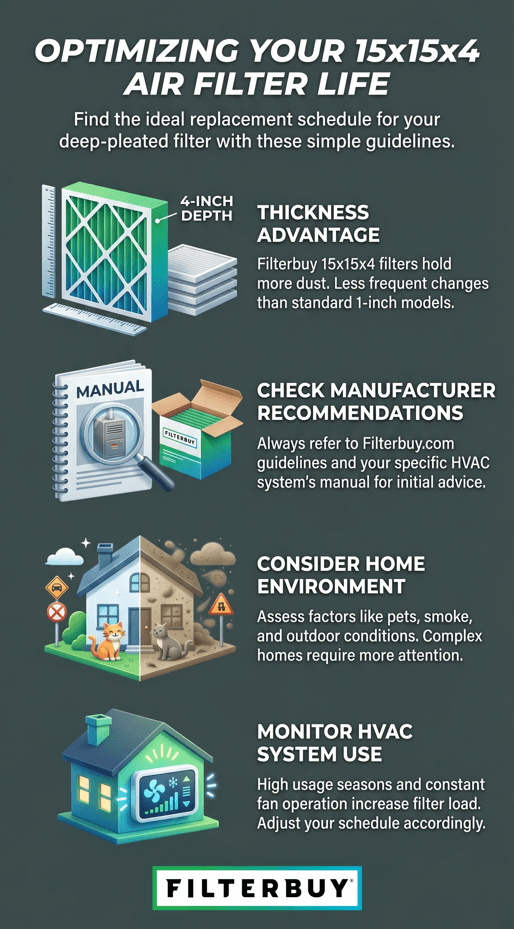
If your HVAC takes a 4-inch filter, you're probably changing it too often. Most last 6 to 12 months in a normal home. Below: what determines your real schedule, what shortens it (pets, allergies, our South Florida humidity), and what to look for when it's actually time to swap.
TL;DR Quick Answers
15x15x4 Air Filters
A 15x15x4 air filter is a 4-inch deep pleated HVAC filter measuring roughly 14.5" x 14.5" x 3.75" actual size. It lasts 6 to 12 months in a typical home, far longer than the 1-inch filters most people grew up swapping every 30 days. The 4-inch depth gives roughly 4 to 5 times the pleated surface area, which means longer filter life and less strain on your HVAC. MERV rating, pets, allergies, and local humidity all shift the timeline. Check it monthly. Replace it when it actually looks dirty, not when the calendar says so.
Top 5 Takeaways
Most 15x15x4 air filters last 6 to 12 months. Not 30 days like the 1-inch filters at the hardware store.
4-inch filters give you 4–5x more surface area than 1-inch filters. That's why they last longer and run more easily on your HVAC system.
MERV rating sets your real schedule. MERV 8 lasts longest, MERV 13 needs swapping more often. Pick the right rating for your home, not the highest number on the shelf.
Pets, allergies, and South Florida humidity can cut your replacement window by 30 to 50 percent.
Check by sight, not by date. A grey or brown filter is applied. That's true even if you put it in two months ago.
Why The 'Change It Every Month' Rule Doesn't Apply To A 15x15x4 Filter
The monthly replacement habit comes from 1-inch filters. Picture a thin sheet of pleated paper that fills up fast because there isn't much room to catch anything. A 15x15x4 filter is a different animal.
Stack four inches of deeply pleated media into the same slot, and a few things change:
Surface area jumps to roughly 4 to 5 times what a 1-inch filter offers.
Each pleat holds more dust before the pressure drop starts climbing.
Your blower motor pushes air through with less effort, which means less wear and a lower power bill.
The filter keeps working at full efficiency for months, not weeks.
If you've never thought about how a pleated filter actually does its job, the basics of air filter design are worth a quick read. Once you see how the media catches particles, the longer schedule makes a lot more sense.
A 15x15x4 filter wants to be left alone. Check it monthly if you want peace of mind. Replace it when it actually looks dirty, not when the calendar says so.
Your Real Replacement Schedule By MERV Rating
MERV rating changes everything about how long a filter lasts. Higher MERV catches more, but it also fills up faster. Here's what we see in actual Palm Beach Gardens homes.
15x15x4 MERV 8 (standard households)
Catches dust, lint, and pollen.
Lasts 9 to 12 months in a no-pet, no-allergy home.
South Florida humidity may bring that down to 6 to 9 months.
15x15x4 MERV 11 (pets, mild allergies)
Adds pet dander, mold spores, and finer dust to the catch list.
Our default recommendation for Florida households with one or two pets.
15x15x4 MERV 13 (allergies, asthma, smoke)
Captures bacteria, virus-sized particles, and wildfire smoke.
If you're considering MERV 13, read up on how MERV 13 furnace filters keep your HVAC running efficiently. Your system has to handle the extra resistance, and it's worth knowing what to look for before you upgrade.
15x15x4 carbon filters (odors, smoke, VOCs)
A pleated filter with an activated carbon layer built in.
Carbon saturates faster than the pleated media clogs.
Replace every 3 to 4 months, sooner if you cook with gas or have indoor pets.
What Speeds Up Replacement (Especially Down Here In South Florida)
Most national guides skip the part that matters most for anyone reading this in Florida. Our HVAC systems run harder than almost anywhere else in the country, which is why filters here age roughly twice as fast as filters in cooler, drier climates. The biggest accelerators we run into on service calls:
Year-round AC. Your system runs 10 months a year here versus 4 to 6 months up north.
High humidity. Moisture loads the filter media faster and feeds microbial growth inside the pleats.
Pets. Each cat or dog roughly doubles the particulate load on the filter.
Indoor smoking or candles. Carbon layers saturate fast, and pleats clog quickly.
Nearby construction or renovation. Drywall dust will clog a filter in weeks.
Allergy or asthma in the home. Drop your interval by 30 to 40 percent.
5 Signs Your 15x15x4 Filter Is Done
Forget the calendar for a second. If you see any of these, change it today.
The filter media is grey or brown instead of white or blue.
Visible dust shows up on your supply vents within a week of cleaning them.
Allergy symptoms flare up indoors, even with windows closed.
Your HVAC runs longer to reach the thermostat setpoint.
A musty or stale smell hits when the AC kicks on.
Any one of these is reason enough. Two or more, and you've been running a clogged filter for a while.
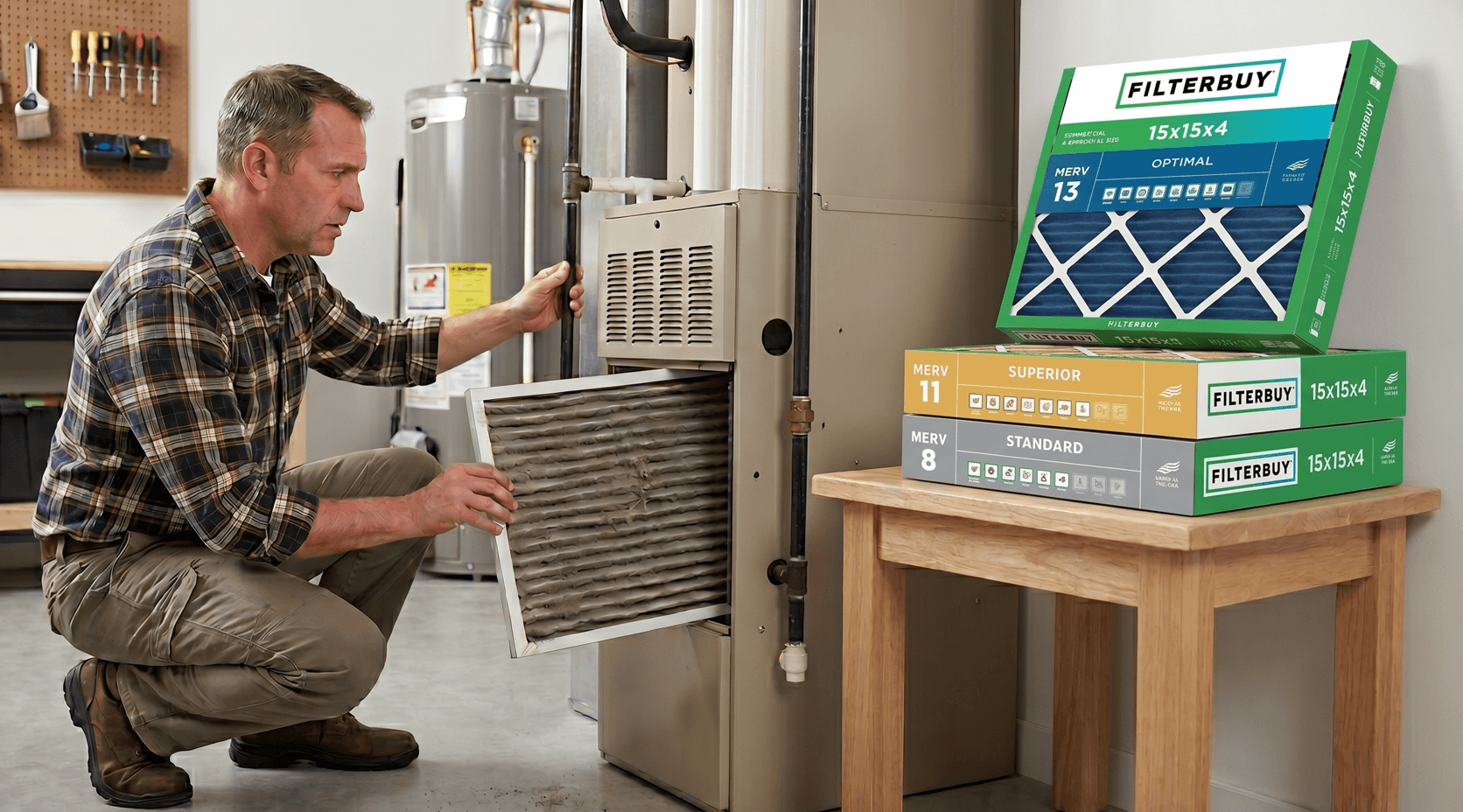
"After fifteen years of HVAC service calls in Palm Beach County, I can tell you the most common mistake homeowners make isn't picking the wrong filter. It's swapping a perfectly good 4-inch filter every month out of habit. We've pulled 15x15x4 filters at the 8-month mark that still measured within the pressure drop spec. Check it. Don't guess."
Essential Resources On 15x15x4 Air Filters
When customers want to verify what we tell them, these are the seven sources we send them to. All federal agencies or peer-reviewed associations are worth bookmarking.
1. The Federal Guide To Picking The Right HVAC Filter
The EPA's plain-English breakdown covers how filters work, which MERV rating fits which home, and how to install them so air doesn't bypass the media. We point most customers here first when they want to confirm what we tell them.
Source: EPA Guide To Air Cleaners In The Home
2. The DOE On When To Check And Change Filters
The U.S. Department of Energy's air conditioner maintenance guide spells out filter replacement timing, what goes wrong when you let it slide, and why a clean filter is the cheapest HVAC upgrade you'll ever make.
Source: Department Of Energy Air Conditioner Maintenance Guide
3. ENERGY STAR On Keeping Your HVAC System Running Lean
A practical maintenance walkthrough from ENERGY STAR. It ties filter timing directly to lower utility bills and longer equipment life, which helps when a customer wants the dollars-and-cents argument.
Source: ENERGY STAR Guide To HVAC System Efficiency
4. CDC Guidance On Indoor Air Filtration For Respiratory Health
The CDC's recommendations on MERV-13 filtration and central HVAC for lowering exposure to viruses, smoke, and other airborne contaminants. If anyone in your house is immunocompromised, this one is worth a careful read.
Source: CDC Steps For Cleaner Indoor Air
5. The American Lung Association On Cleaning The Air You Breathe
The Lung Association's homeowner-friendly breakdown explains how HVAC filters affect lung health, what to look for in a filter, and where filtration fits into the bigger picture of indoor air quality.
Source: American Lung Association Air Cleaning Guide
6. AAFA's Allergen-Control Playbook For Your Home
The Asthma and Allergy Foundation of America walks through the indoor allergens that actually trigger symptoms and where a properly chosen HVAC filter fits into reducing exposure. If you have pets or seasonal allergies, this one applies to you directly.
Source: AAFA Guide To Controlling Indoor Allergens
7. The Allergist's Take On HVAC Filters And CADR Ratings
The American College of Allergy, Asthma & Immunology explains how filters fit into allergy management, including what a HEPA-class equivalent looks like at home and how MERV ratings translate into real relief.
Source: ACAAI Air Filter Treatment Guide
Supporting Statistics
Three numbers we lean on when we explain filter replacement to homeowners. Every one of them comes from a peer-reviewed study or a federal source, not from marketing copy.
1. HVAC Filtration Can Cut Indoor Allergens By Up To 89%
A 22-home study published in the NIH's National Library of Medicine measured allergen levels with and without air filtration in active bedrooms.
Median reductions: 75% for dust mite allergens, 77% for cat allergens, and 89% for dog allergens.
Translation: when we tell pet owners a MERV 11 filter is worth it, this is the study we're pointing at.
Source: NIH Study On Air Filtration And Indoor Allergens
2. MERV 11–12 Filters Can Pull Indoor Particles Down To About 2 Microns
According to Dr. James Sublett, a board-certified allergist, swapping your factory HVAC filter for a MERV 11 or MERV 12 and running the fan continuously will pull indoor particles down to about 2 microns.
That window covers most allergy triggers (pollen, pet dander, mold spores), along with a good chunk of smoke and finer household dust.
For allergy or asthma households, this hits the sweet spot between filtration strength and airflow, without the system strain a true HEPA setup can put on a residential HVAC.
Source: Allergy & Asthma Network On HEPA And HVAC Filtration
3. Homes Use About 19% Of Total U.S. Energy, Most Of It For HVAC
NIST's residential testing facility data shows just how much of a household power bill ties back to heating and cooling.
A clogged 15x15x4 filter makes that system work harder for every degree of comfort.
In our service calls, we've watched energy bills drop noticeably the month after a long-overdue filter swap.
Source: NIST Residential HVAC Performance Project
Final Thoughts & Opinion
After years of pulling 15x15x4 air filters out of South Florida homes, here's what we've learned. Most people do more damage by overthinking this than by underthinking it.
Three things actually matter.
Match the MERV rating to your household. MERV 11 for most homes. MERV 13 if anyone has asthma or severe allergies. MERV 8 only if your system specifically calls for it.
Check the filter once a month. Not to change it. Just to look at it. If it's grey or brown, swap it. If it still looks white-ish, leave it.
Plan for a 6-month replacement in Florida. Anywhere else, 9 to 12 months is normal. The humidity here changes the math.
Our unpopular opinion: stop buying 12-packs of the cheapest 1-inch filter to swap monthly. If your system fits a 4-inch slot, move to 15x15x4 MERV 11 air filters and buy a 4-pack. You'll save money over the year, your HVAC will run quieter, and your air will actually be cleaner.
Filters are one of those rare household items where buying better and buying less go together.
Frequently Asked Questions
Q: Can I Really Leave A 15x15x4 Air Filter In For A Full Year?
A: Yes, in the right conditions. A MERV 8 or MERV 11 pleated 15x15x4 filter in a low-traffic, no-pet home can run 9 to 12 months. We've personally pulled filters at the 11-month mark that still passed pressure drop tests. Humid climates like ours in South Florida usually bring that window down to 6 to 9 months.
Q: Is A 15x15x4 Filter Really Better Than A 15x15x1?
A: If your system accepts a 4-inch slot, the answer is yes every time. The 4-inch depth gives you roughly 4 to 5 times the pleated surface area, much longer life, and noticeably less strain on your blower motor. The only reason not to upgrade is if your HVAC system physically can't accept the depth.
Q: What MERV Rating Should I Actually Use?
A: MERV 11 is our default recommendation for most South Florida homes. Move up to MERV 13 if anyone has asthma, severe allergies, or you're dealing with smoke from wildfires or cooking. Don't jump to MERV 13 by default. It puts more resistance on your system, and not every HVAC is built to handle it.
Q: Where Can I Find A 15x15x4 Filter Near Me?
A: Some Home Depot and Lowe's locations carry it in MERV 8, but the selection is hit-or-miss because it isn't the most common size. For MERV 11, MERV 13, carbon, or a 4-pack, factory-direct online is almost always the faster and cheaper option compared to running store-to-store.
Q: Does A Dirty 15x15x4 Filter Actually Damage My HVAC?
A: Yes. We've traced burnt-out blower motors and frozen evaporator coils back to filters that should have been swapped six months earlier. A clogged filter makes the system work harder. That raises your power bill in the meantime and shaves years off the equipment. The cheapest HVAC repair is the one you avoid by swapping a $25 filter on time.
Q: What's The Actual Size Of A 15x15x4 Air Filter?
A: Nominal: 15" x 15" x 4". Actual: usually around 14.5" x 14.5" x 3.75". Pull your old filter, measure it with a tape, and compare. A 1/8-inch gap on a side is normal and fine. A 1/2-inch gap means unfiltered air is bypassing the filter. That's when a custom 15x15x4 cut to your exact slot size is worth ordering.
Q: Should I Buy A 4-Pack Or Single Filters?
A: Almost always the 4-pack. On a 6 to 12-month replacement schedule, a 4-pack covers 2 to 4 years for one home. The per-filter price drops, you stop running out, and auto-delivery takes the "did I change it?" mental load off your hands entirely.
Get The Right 15x15x4 Filter And Move On With Your Day
Pick the MERV rating that fits your home, set a 6 to 12 month reminder, and let the filter do its job. Browse factory-direct 15x15x4 air filters with free shipping, custom sizing, and auto-delivery. The only thing left for you to do is enjoy the cleaner air.
Learn more about HVAC Care from one of our HVAC solutions branches…
Filterbuy HVAC Solutions - Weston, FL
2573 Mayfair Lane, Weston, FL 33327
(754) 296-3528
https://maps.app.goo.gl/E3tjmKf5VSWYghGc7